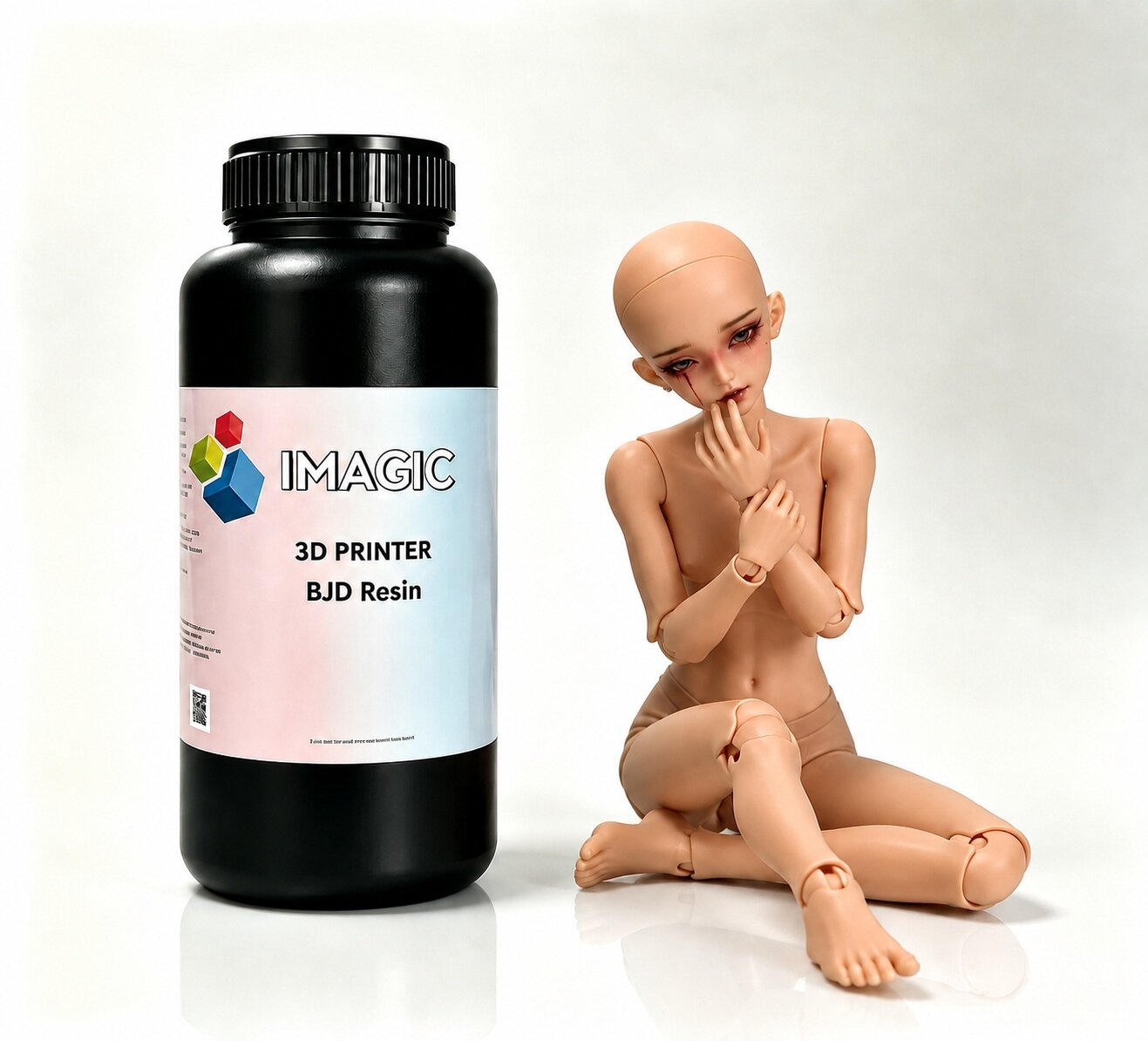
The Complete Guide to Choosing the Right 3D Printing Resin
Choosing the right resin is one of the most important decisions in resin 3D printing.
Whether you are printing highly detailed miniatures, functional prototypes, jewelry patterns, engineering components, dental models, or flexible parts, the resin you choose directly affects the final result.
The right resin can give you excellent detail, smooth surfaces, reliable dimensional accuracy, and the mechanical performance your application requires. The wrong resin, however, can result in brittle parts, excessive deformation, failed prints, poor surface quality, or components that simply cannot withstand real-world use.
With so many options available—including Standard, Tough, ABS-Like, High-Temperature, Flexible, Water-Washable, Castable, Dental, and Engineering resins—it is easy to feel overwhelmed.
So, how do you know which resin is right for your project?
The answer is not simply to choose the strongest or most expensive resin. Instead, you need to consider how the part will be used, what properties it needs, how it will be printed, and how it will be post-processed.
In this guide, we'll explain the most important resin properties, compare the major resin categories, and show you how to select the right material for different applications.
1. Start With the Application
Before looking at resin specifications, start with the most important question:
What are you going to use the printed part for?
Different applications require completely different material characteristics.
A miniature may prioritize fine details and surface quality.
A mechanical bracket may require toughness and impact resistance.
A flexible seal may need high elasticity.
A jewelry pattern may need clean burnout characteristics.
A prototype used in a high-temperature environment may require excellent thermal stability.
Therefore, instead of asking:
"Which resin is the best?"
Ask:
"Which resin is best for this specific application?"
A simple way to think about resin selection is:
Application | Recommended Resin Type |
|---|---|
Miniatures & models | Standard / High Detail Resin |
General prototypes | Standard / ABS-Like Resin |
Functional parts | Tough / Durable Resin |
Impact-resistant parts | Tough / Engineering Resin |
Flexible components | Flexible / Elastic Resin |
High-temperature parts | High-Temperature Resin |
Jewelry casting | Castable Resin |
Dental applications | Dental / Biocompatible Resin |
Transparent parts | Clear / Transparent Resin |
Lightweight components | Low-Density / Specialized Resin |
Complex support structures | Water-Washable or suitable support-compatible resin |
This is only a starting point. The final choice should always be based on the actual specifications of the resin and your intended application.
2. Understanding the Most Important Resin Properties
Once you know what your part needs to do, the next step is understanding the material properties that determine performance.
You don't need to be a materials scientist to compare resins.
A few key specifications can tell you a great deal about how a resin will behave.
Tensile Strength
Tensile strength describes how much pulling force a cured material can withstand before it breaks.
It is useful when your printed component will experience tension or pulling forces.
For example, tensile strength can be important for:
Structural components
Mechanical brackets
Housings
Fixtures
Functional prototypes
However, tensile strength should never be considered in isolation.
The strength of a resin-printed part also depends heavily on print orientation, wall thickness, exposure settings, layer adhesion, and post-curing.
Elongation at Break
Elongation at break tells you how much a material can stretch before breaking.
A low value generally indicates a more rigid or brittle material.
A high value indicates that the material can deform more before failure.
This property is particularly important when choosing flexible or impact-resistant resins.
For example:
Low elongation → rigid, detail-oriented applications
High elongation → flexible, shock-absorbing applications
If your part needs to bend repeatedly without cracking, look for a resin with relatively high elongation at break.
Flexural Strength
Flexural strength measures how much bending stress a material can withstand before failure.
This is particularly useful for rigid components such as:
Brackets
Enclosures
Structural prototypes
Mechanical fixtures
Assembly components
If your part needs to maintain its shape under bending loads, flexural strength becomes an important specification.
Impact Strength
Impact strength measures how well a material can withstand sudden forces.
This is different from tensile strength.
A material can have good tensile strength but still be relatively brittle when subjected to sudden impact.
Impact resistance is especially important for:
Protective housings
Tools
Mechanical components
Automotive prototypes
Functional parts
Parts that may be dropped
For these applications, Tough, Durable, or ABS-Like resins are often better choices than standard high-detail resins.
3. Thermal Properties: Will Your Print Survive Heat?
A resin may perform perfectly at room temperature but deform when exposed to heat.
If your printed part will be used near a heat source, inside a vehicle, under strong sunlight, or in an industrial environment, thermal performance becomes critical.
Heat Deflection Temperature
HDT, or Heat Deflection Temperature, indicates the temperature at which a material begins to deform under a specified load.
A higher HDT generally means the material can maintain its shape better at elevated temperatures.
High-temperature resins are therefore useful for applications such as:
Automotive prototypes
Industrial fixtures
Manufacturing aids
Heat-exposed housings
Engineering prototypes
However, HDT should not be treated as the maximum operating temperature of a printed part.
Actual performance depends on load, geometry, print orientation, curing, and other factors.
Glass Transition Temperature
The glass transition temperature, or Tg, describes the temperature range where a polymer changes from a relatively rigid state to a softer and more flexible state.
A higher Tg can be beneficial when a printed part must maintain rigidity in warm environments.
When comparing resins for heat-sensitive applications, consider both Tg and HDT rather than relying on only one number.
4. Optical Properties and Appearance
Not every resin is selected for mechanical performance.
For many applications, appearance is equally important.
Resin 3D printing is particularly well known for producing extremely smooth surfaces and fine details, making it ideal for models, miniatures, collectibles, jewelry, and display prototypes.
High-Detail Resins
If your priority is capturing extremely small details, choose a resin specifically formulated for high-resolution printing.
These resins are suitable for:
Miniatures
Figurines
Jewelry models
Sculptures
Product prototypes
Small mechanical components
They can reproduce fine textures, sharp edges, and small surface features.
Transparent Resins
Clear or transparent resin is designed for applications where light transmission or visual clarity matters.
Typical applications include:
Display models
Light guides
Lens prototypes
Transparent housings
Optical prototypes
Decorative parts
However, achieving truly clear results usually requires careful printing, washing, curing, and post-processing.
Surface roughness, over-curing, scratches, and contamination can all reduce optical clarity.
Color and Surface Finish
Resins are available in a wide range of colors and finishes.
Depending on the formulation, you may find:
Matte finishes
Glossy finishes
Solid colors
Transparent colors
Translucent materials
Special-effect resins
For miniature and artistic applications, appearance may be more important than mechanical performance.
For functional components, however, material properties should usually take priority over color.
5. Viscosity and Printability
A resin's viscosity describes how easily it flows.
Low-viscosity resin flows more easily between the build plate and release film, which can help improve resin replenishment and printing consistency.
Higher-viscosity resins may contain additives or formulations designed for specific mechanical or optical properties, but they may require more attention to temperature and printing conditions.
Resin viscosity can also change significantly with temperature.
This means the same resin may behave differently in a cold workshop compared with a warm printing environment.
Practical tip
If your resin seems unusually thick, check the manufacturer's recommended operating temperature before changing exposure settings.
Temperature can have a significant effect on viscosity and curing behavior.
6. Cure Speed and Exposure Requirements
Different resins respond differently to UV light.
Cure speed is influenced by:
Resin formulation
Printer wavelength
Light intensity
Layer thickness
Exposure time
Resin temperature
A fast-curing resin can potentially reduce exposure time and improve printing efficiency.
However, faster curing is not automatically better.
Overexposure can cause:
Loss of fine details
Increased dimensions
Closed holes
Excessive support attachment
Brittle surfaces
Underexposure can cause:
Weak layers
Poor adhesion
Failed prints
Soft or sticky surfaces
The goal is to find the correct exposure window for your specific resin and printer.
7. The Main Types of 3D Printing Resin
Now that we understand the important properties, let's look at the major resin categories and where each one performs best.
Standard Resin — The Everyday Choice
Standard resin is designed for general-purpose resin printing.
It usually offers a good balance between:
Detail
Surface quality
Dimensional accuracy
Printability
Cost
Standard resin is an excellent starting point for beginners and is particularly suitable when the printed part does not need to withstand significant mechanical stress.
Best applications
Miniatures
Figurines
Decorative models
Prototypes
Educational models
Concept models
Display parts
Choose Standard Resin when:
Appearance and detail matter more than extreme mechanical performance.
Tough Resin — Designed for Impact and Durability
Tough resin is formulated to provide greater impact resistance and toughness than standard resin.
It is a better choice when your printed part needs to survive drops, impacts, repeated handling, or mechanical stress.
Typical applications
Mechanical prototypes
Enclosures
Brackets
Snap-fit components
Functional prototypes
Protective parts
Tough resin is particularly useful when standard resin is simply too brittle.
Choose Tough Resin when:
Your part needs to withstand real-world handling and mechanical stress.
ABS-Like Resin — Strength With a Familiar Engineering Feel
ABS-Like resin is formulated to simulate some of the characteristics associated with ABS plastics.
It generally offers improved toughness and impact resistance compared with standard resin while maintaining the excellent surface quality associated with resin printing.
It is often used for:
Functional prototypes
Consumer product prototypes
Mechanical housings
Enclosures
Engineering models
Choose ABS-Like Resin when:
You need a more durable material for functional prototypes without sacrificing resin-printing detail.
Flexible Resin — For Rubber-Like Components
Flexible resin is designed for applications where rigid materials are not suitable.
Depending on its formulation and hardness, flexible resin can produce parts ranging from slightly flexible to highly elastic.
Typical applications
Gaskets
Seals
Grips
Protective covers
Flexible connectors
Wearable prototypes
Shock-absorbing components
Flexible resin can be more sensitive to printing and post-curing conditions than standard resin, so always follow the manufacturer's recommended workflow.
Choose Flexible Resin when:
Your component needs to bend, compress, stretch, or absorb vibration.
High-Temperature Resin — For Heat-Resistant Applications
High-temperature resin is designed for applications where conventional resins may soften or deform.
These materials are often formulated with high thermal resistance and are used for demanding prototypes and industrial applications.
Typical applications
Heat-resistant fixtures
Manufacturing aids
Automotive prototypes
Engineering prototypes
Mold inserts
Electronic component housings
When evaluating high-temperature resin, pay particular attention to:
HDT
Tg
Post-curing requirements
Recommended exposure
Required post-curing conditions
Choose High-Temperature Resin when:
Your printed part must maintain its shape in elevated-temperature environments.
Castable Resin — Designed for Investment Casting
Castable resin is specifically developed for applications such as jewelry and precision casting.
Instead of being used as the final part, the printed model becomes part of the casting process.
The resin is burned out during the investment casting process, leaving a cavity that can then be filled with metal.
Important characteristics
A good castable resin should provide:
Fine detail
Low ash or residue after burnout
Controlled expansion
Clean burnout
Reliable dimensional accuracy
Typical applications
Jewelry
Rings
Pendants
Dental casting patterns
Small precision castings
Choose Castable Resin when:
Your printed model is intended to become a pattern for investment casting.
Dental and Biocompatible Resins
Dental resins represent a specialized category with requirements that go far beyond ordinary 3D printing.
Depending on the intended application, dental materials may be developed for:
Dental models
Surgical guides
Orthodontic applications
Temporary restorations
Other specialized medical or dental applications
The key point is that "biocompatible" is not a universal label.
Different applications require different certifications, testing, and processing procedures.
Always verify the manufacturer's intended use, certification, and regulatory documentation before using a resin in a medical or dental application.
Choose Dental Resin when:
The material is specifically certified and intended for your required dental or medical application.
Engineering Resin — Performance for Demanding Applications
Engineering resins are designed around specific performance requirements rather than simply appearance.
Depending on the formulation, they may prioritize:
High strength
High toughness
Heat resistance
Chemical resistance
Dimensional stability
Wear resistance
High stiffness
Engineering resins are useful when standard and tough resins cannot meet the requirements of your application.
Typical applications
Industrial prototypes
Mechanical components
Automotive parts
Manufacturing fixtures
Functional assemblies
Engineering validation
Choose Engineering Resin when:
Your printed part needs to simulate or perform like a technical component rather than a simple model.
Water-Washable Resin — Convenience With Trade-Offs
Water-washable resin is designed to simplify the cleaning process after printing.
Instead of using a solvent such as isopropyl alcohol for the initial cleaning stage, the printed part can be washed with water according to the manufacturer's instructions.
This can make the workflow more convenient, especially for beginners.
However, water-washable does not mean that uncured resin is harmless or that it can simply be poured into a drain.
Liquid resin and contaminated cleaning water should be handled and disposed of responsibly according to local regulations and the manufacturer's safety guidance.
Choose Water-Washable Resin when:
You prioritize a simpler cleaning workflow and your application is compatible with the material's mechanical properties.
8. Match Resin to Your Application
The easiest way to choose resin is to work backward from the final application.
For Miniatures
Choose:
Standard / High-Detail Resin
Prioritize:
Fine details
Surface finish
Dimensional accuracy
Easy post-processing
For Functional Prototypes
Choose:
Tough / ABS-Like / Engineering Resin
Prioritize:
Impact resistance
Strength
Dimensional stability
Durability
For Flexible Components
Choose:
Flexible Resin
Prioritize:
Elongation
Flexibility
Tear resistance
Recovery after deformation
For Outdoor or Heat-Exposed Parts
Choose:
High-Temperature / Engineering Resin
Depending on the environment, also consider UV stability and long-term aging.
For Jewelry
Choose:
Castable Resin
Prioritize:
Fine details
Clean burnout
Dimensional accuracy
Surface quality
For Dental Applications
Choose:
Certified Dental Resin
Prioritize:
Intended application
Biocompatibility
Regulatory compliance
Dimensional accuracy
9. Don't Forget Your Printer
Resin selection is not only about the material.
Your printer must also be compatible with the resin.
Before purchasing, check four important things.
1. Printer Wavelength
Most modern resin printers use UV light around the 405 nm wavelength, but you should always confirm compatibility between your printer and the resin.
2. Light Source
Different printers can have different optical systems and light intensities.
A resin profile that works perfectly on one printer may require adjustment on another.
3. Build Volume and Model Size
Large models may require different support strategies and exposure settings compared with small models.
4. Resin Profile Availability
Whenever possible, start with the manufacturer's recommended profile for your specific printer.
This gives you a reliable baseline before fine-tuning exposure, lift speed, and other parameters.
10. Understanding Resin Profiles
A resin profile is essentially a collection of printer settings optimized for a particular resin and printer combination.
Typical parameters include:
Layer height
Normal exposure time
Bottom exposure time
Bottom layer count
Lift height
Lift speed
Retract speed
Rest time
Anti-aliasing settings
These settings can dramatically affect the final print.
Layer Height
Lower layer heights can produce finer vertical detail and smoother surfaces.
For example:
0.05 mm → common general-purpose setting
0.03 mm → finer detail
0.02 mm or below → specialized high-detail applications
However, smaller layers increase printing time.
Choose the layer height according to the level of detail actually required.
Normal Exposure Time
Normal exposure controls how long each layer is cured.
Too little exposure can cause:
Weak prints
Poor layer adhesion
Missing details
Failed sections
Too much exposure can cause:
Loss of fine details
Enlarged features
Closed holes
Excessively brittle parts
Always start from the resin manufacturer's recommended exposure range.
Bottom Exposure
Bottom layers generally require longer exposure than normal layers because they need strong adhesion to the build platform.
If bottom exposure is too low, the model may detach.
If it is excessively high, removing the print from the platform can become unnecessarily difficult and the first layers may become over-cured.
11. Post-Curing Matters
Printing is not the end of the resin workflow.
After printing, the model typically needs to be:
Removed from the build plate
Washed
Dried
Support structures removed
Fully cured
Inspected and finished
Post-curing is especially important because the printed part may still contain partially reacted material after printing.
The final mechanical properties of a resin can depend significantly on post-curing time and conditions.
Important
Do not assume that "more curing is always better."
Over-curing can change properties such as:
Brittleness
Flexibility
Color
Surface characteristics
Follow the manufacturer's recommended post-curing process for the specific resin.
12. Washing and Cleaning
Proper cleaning is essential for achieving a high-quality surface.
Residual uncured resin can leave a sticky surface and interfere with subsequent curing.
Depending on the resin type, cleaning may involve:
Isopropyl alcohol
Water
Dedicated cleaning solutions
Always follow the manufacturer's instructions.
After washing, allow the print to dry completely before post-curing.
Trapped cleaning liquid or residual resin can affect the final appearance and performance.
13. Resin Storage and Moisture Control
Although resin is less commonly discussed in terms of moisture than filament, storage conditions still matter.
To maintain consistent performance:
Keep resin containers tightly sealed.
Store resin away from direct sunlight.
Avoid unnecessary UV exposure.
Keep the resin within the manufacturer's recommended temperature range.
Avoid contaminating the bottle with cured resin or debris.
Mix resin appropriately before printing if recommended.
If resin has been stored for an extended period, inspect it for unusual color changes, separation, particles, or changes in viscosity before use.
14. Resin Safety: What You Need to Know
Liquid photopolymer resin should always be handled carefully.
Uncured resin can irritate the skin and eyes and may cause sensitization with repeated exposure.
Wear protective equipment
When handling liquid resin, use appropriate:
Nitrile gloves
Eye protection
Protective clothing
Avoid direct skin contact whenever possible.
Maintain ventilation
Use your printer in a well-ventilated environment and follow the resin manufacturer's safety recommendations.
Even low-odor resin should not automatically be assumed to be harmless.
Never dispose of liquid resin down the drain
Do not pour uncured resin into sinks or drains.
Waste resin and contaminated materials should be handled according to local waste-disposal requirements.
Before disposal, follow the manufacturer's instructions for curing and waste handling.
15. Common Resin Printing Problems
Even with the right resin, problems can happen.
Understanding the cause can save a lot of time.
Problem 1: Prints Are Not Sticking to the Build Plate
Possible causes include:
Insufficient bottom exposure
Incorrect build plate leveling
Poor build plate surface condition
Incorrect lift settings
Low resin temperature
Inadequate supports
Start by checking build plate leveling and the recommended bottom exposure settings.
Problem 2: Prints Are Too Brittle
Possible causes include:
Over-curing
Choosing a rigid standard resin for a high-stress application
Excessive post-curing
Incorrect resin selection
If the application requires impact resistance, consider switching to a Tough, ABS-Like, or Engineering resin.
Problem 3: Fine Details Are Missing
Possible causes include:
Excessive exposure
Incorrect layer height
Poor optical performance
Insufficient printer resolution
Incorrect support placement
Reducing exposure slightly and using an appropriate high-detail resin may improve the result.
Problem 4: Warping
Warping can be caused by:
Poor orientation
Insufficient supports
Large flat cross-sections
Excessive peel forces
Incorrect exposure
Improper curing
Changing model orientation and reducing large cross-sectional areas can often make a major difference.
Problem 5: Sticky Surface
A sticky surface is often caused by incomplete cleaning or insufficient curing.
Make sure the print is thoroughly washed and completely dry before post-curing.
16. Resin Selection by Key Performance
If you are comparing several resins, this simple framework can help.
If You Need... | Look For... |
|---|---|
Fine details | High-detail / Standard Resin |
Smooth surface | Standard / High-detail Resin |
Impact resistance | Tough / ABS-Like Resin |
High flexibility | Flexible Resin |
High heat resistance | High-Temperature Resin |
Casting | Castable Resin |
Medical applications | Certified Dental / Biocompatible Resin |
Engineering performance | Engineering Resin |
Transparency | Clear / Transparent Resin |
Easy cleaning | Water-Washable Resin |
Remember that these categories can overlap.
For example, an engineering resin may also be tough, heat-resistant, or chemically resistant.
Always compare the actual technical data sheet rather than relying only on the product category.
17. How to Read a Resin Technical Data Sheet
A Technical Data Sheet, or TDS, is one of the most useful resources when comparing professional resins.
Instead of focusing only on marketing claims, look for measurable properties.
The most useful specifications often include:
Tensile strength
Tensile modulus
Elongation at break
Flexural strength
Flexural modulus
Impact strength
HDT
Tg
Viscosity
Density
Shrinkage
Recommended exposure
Post-curing conditions
For example, if you need a rigid mechanical component, pay particular attention to tensile and flexural properties.
If flexibility is important, focus on elongation.
If the part will experience heat, look closely at HDT and Tg.
If the part needs to survive impacts, impact strength and elongation are particularly relevant.
18. A Simple Resin Selection Workflow
Still unsure which resin to choose?
Follow these six steps.
Step 1: Define the application
Is the part decorative, functional, flexible, mechanical, medical, or intended for casting?
Step 2: Identify the most important property
Do you need:
Detail?
Strength?
Toughness?
Flexibility?
Heat resistance?
Chemical resistance?
Transparency?
Choose the property that matters most.
Step 3: Check your printer
Confirm:
Wavelength
Resin compatibility
Recommended exposure
Build plate requirements
Step 4: Check the TDS
Compare the actual mechanical and thermal specifications.
Step 5: Start with the recommended profile
Use the manufacturer's settings as your starting point.
Step 6: Test before producing the final part
Print a small calibration model or prototype before committing to a large or expensive print.
19. The Golden Rules of Resin Selection
If you don't want to memorize everything in this guide, remember these simple rules:
Want beautiful models and fine details?
→ Choose Standard or High-Detail Resin
Need stronger functional parts?
→ Choose Tough or ABS-Like Resin
Need flexibility?
→ Choose Flexible Resin
Need high-temperature resistance?
→ Choose High-Temperature Resin
Making jewelry for casting?
→ Choose Castable Resin
Working on dental or medical applications?
→ Choose a properly certified Dental/Biocompatible Resin
Need engineering-level performance?
→ Choose Engineering Resin
Need transparent parts?
→ Choose Clear/Transparent Resin
Want a simpler washing process?
→ Consider Water-Washable Resin
Conclusion: The Best Resin Is the One That Fits Your Project
There is no single resin that is perfect for every 3D printing application.
Standard resin is excellent for detailed models and everyday printing.
Tough and ABS-Like resins provide better durability for functional parts.
Flexible resin is ideal when elasticity and impact absorption are important.
High-temperature and engineering resins are designed for demanding technical applications.
Castable resin opens the door to jewelry and precision casting.
Dental and biocompatible resins serve specialized applications where certification and material safety are essential.
The key is to stop thinking about resin as simply "a material for printing" and start thinking about it as part of the final product.
Ask yourself:
What does the part need to do?
Where will it be used?
What stresses will it experience?
How much heat will it encounter?
Does it need to bend or remain rigid?
How important are detail and appearance?
What post-processing will be required?
Once you answer these questions, choosing the right resin becomes much easier.
And remember: the resin with the highest strength, highest heat resistance, or highest price is not necessarily the best resin for your project.
The best resin is the one that provides the right balance of printability, performance, appearance, durability, and cost for the application.
Before starting a large print, always check the manufacturer's Technical Data Sheet, recommended resin profile, safety information, and post-processing instructions.
With the right material, the right settings, and a little testing, resin 3D printing can produce remarkably detailed and functional parts—from miniature models and jewelry to engineering prototypes and specialized industrial components.